
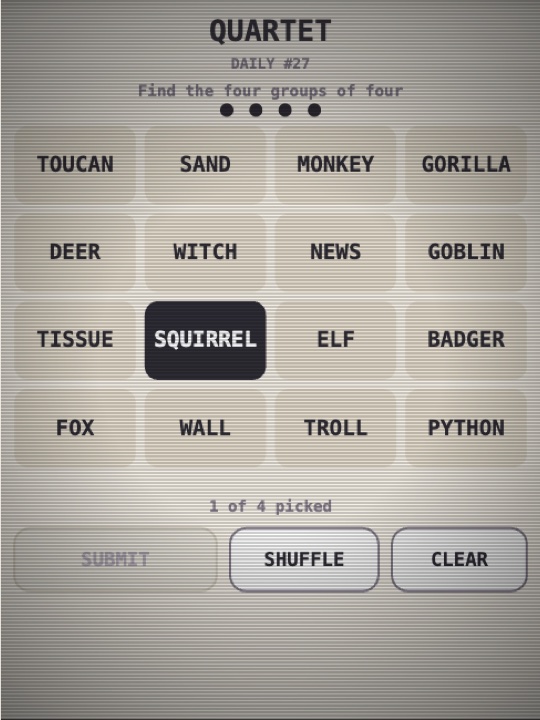
How to submit a group in Quartet
Choose four of the words on the board, then press Submit. On touch screens, tap a word again to remove it from the selection before committing. A correctly submitted group is solved and leaves fewer words to consider. There are four groups in the daily puzzle. Four incorrect submissions can end the game, and the board also has a timer, so spend a little time on the choice before submitting.
Name the rule before picking the last tile
Form a sentence that describes all four words. “Things associated with a kitchen” is broad enough to pull in a dozen possibilities. “Utensils used for serving” gives you something concrete to test. Some categories depend on what a word can mean in a particular context. Others use a common word that goes before or after every member. Say the entire resulting phrase for each candidate to check that the connection works in all four cases.
Handle a category with five plausible words
Imagine a board with bat, ball, glove, base, and pitcher. They all have something to do with baseball, which makes submitting the first four risky. If pitcher also fits a clearer category with three other containers, solve the container group first. Now the remaining four baseball candidates can stand on their own. This example demonstrates the overlap that can appear on a board and gives no clues about today's groups.
Let each solved set change the next search
When a set leaves the active board, read the remaining words from the beginning. A word that looked like a noun might be a verb in its intended group. Look at spelling, sounds and common phrases if familiar categories no longer account for four entries. One narrow connection can make two large, uncertain clusters easier to separate. Trying to name all four categories before making the first move is helpful only if you are still learning something new.
Keep track of a group that failed
A rejected set gives you evidence about those four words as a unit. Before swapping one out, check whether the three you are keeping even share the same precise rule. If you only remember that the last word seemed weak, you may miss that two of the stronger words are meant for separate groups. A fresh look can preserve your remaining slips. When the result is revealed, see which word made the tempting false set plausible and where it actually belonged.